

Reviewed · SAL TOURS
Kitesurf Lessons in Cape Verde
Start with the kite, not the postcard. This two-hour lesson in Sal gives you a practical first taste of the sport Cape Verde is known for, with IKO-qualified instructors guiding you from a small training kite to the real equipment. I like the clear step-by-step teaching, and I like that the lesson ends in the water rather than stopping on the beach. The main consideration is that you must be able to swim and have a moderate level of fitness.
You meet at Surf Hub Cabo Verde in Santa Maria, prepare your equipment, and travel to Kitebeach for the session. The private format means your group gets the instructor’s attention, but the $141.14 price is easier to justify if you value personal coaching more than a low-cost group introduction.
In This Review
- Key points at a glance
- Why this Sal lesson works for first-timers
- Meeting at Surf Hub Cabo Verde in Santa Maria
- Learning with a small kite on the beach
- Moving to the full-size kite and safety systems
- Entering the water for body dragging
- What makes Kitebeach a worthwhile setting
- The private format and what it means for value
- The people behind the school
- Who should book this experience
- Timing, weather, and cancellation advice
- My verdict on the Sal kitesurf lesson
- FAQ
- Where does the kitesurf lesson begin?
- Where does the activity end?
- How long does the lesson last?
- Do I need to know how to swim?
- Is this a private activity?
- What happens if bad weather cancels the lesson?
Key points at a glance
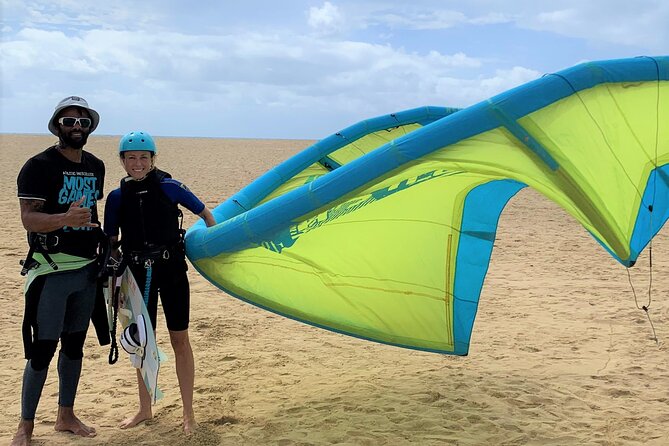
- Begin with a small training kite: You learn the basic controls on land before handling larger equipment.
- Progress to full-size gear: The lesson covers safety systems and the skills needed before entering the water.
- Finish with body dragging: You use the kite in the sea while the instructor guides your first water-based practice.
- Learn at Kitebeach: The lesson takes place at one of Sal’s well-known kitesurfing locations.
- Private instruction: Only your group participates, which can make questions and corrections easier.
- Free cancellation up to 24 hours ahead: Bad weather may lead to a new date or a full refund.
Why this Sal lesson works for first-timers
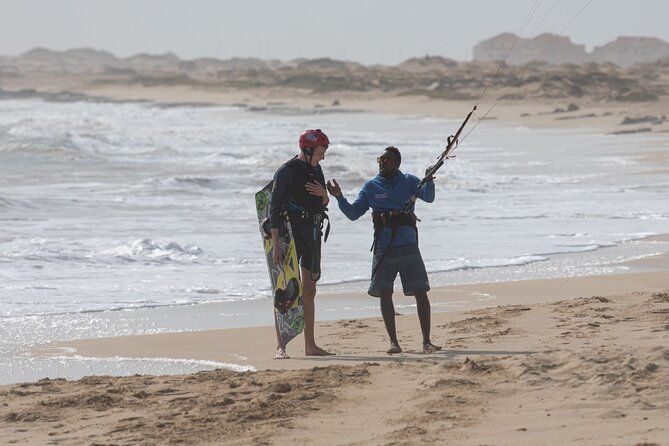
Kitesurfing can look simple from the beach. A person holds a bar, a kite rises, and the wind does the rest. In practice, the kite can pull hard and react quickly. A good first lesson must teach control and safety before asking you to move through the water.
That is the sensible shape of this experience. You start with a small training kite on the beach, where the instructor can explain the basic flying skills without putting you straight into the sea. This early stage helps you understand how the kite responds when you steer it, how the wind affects it, and how to keep your movements controlled.
You then move to a larger kite. This is an important change, not just a bigger version of the same exercise. The equipment has more power, so the lesson includes the safety systems and handling skills you need before entering the water.
I like this progression because it respects the sport. You are not promised an instant ride across the bay. Instead, you get the first building blocks that can lead to independent kitesurfing with more lessons.
More things to do on Sal:
- Sal: Island Experience Tour with a Certified Local Guide
★ 4.8 · 3,249 reviews - Sal: All-Inclusive Salt Lake, Blue Eye and Shark Bay Tour
★ 4.7 · 2,033 reviews - Experience on Sal Island with native and certified guide (including sharks)
★ 5.0 · 1,166 reviews
Meeting at Surf Hub Cabo Verde in Santa Maria
Your day begins at Surf Hub Cabo Verde, on Rua 15 de Agosto in Santa Maria. This is the practical starting point for equipment preparation and instructions before you head to Kitebeach.
The shop meeting gives the session a proper beginning. You can get fitted for the necessary equipment, listen to the plan, and ask questions before the wind and water become part of the lesson. It also avoids the confusion of trying to meet an instructor directly on a broad beach.
The activity ends back at the same meeting point. That makes the arrangement simple, especially if you are staying in Santa Maria and want a lesson that fits into a larger beach day.
The school operates Monday through Saturday from 9:00 a.m. to 4:30 p.m. The schedule is listed for the periods running through July 24, 2025, and from July 25, 2025, through July 24, 2026. Since wind and weather affect kitesurfing, confirm the time when booking rather than assuming every available hour will suit the conditions.
Learning with a small kite on the beach
The first lesson takes place on land with a small training kite. This is the least glamorous part of the experience, but it may be the most useful.
You learn how to fly the kite and begin to understand its power zone. The instructor can watch your hands, correct your steering, and explain what to do when the kite moves in an unexpected way. These are skills you need later, when the kite is larger and the water makes simple tasks less simple.
I would pay close attention here, even if you are eager to get wet. The beach practice is where you learn the basic language of the equipment. Rushing past it can make the water session harder and less safe.
The school is registered with the International Kiteboarding Organization, and its instructors are IKO qualified. That does not guarantee that every student will progress at the same speed, but it gives you a useful standard for the teaching and safety structure.
The lesson is also private for your group. That matters during the training-kite stage because instructors can focus on your steering and give corrections suited to your pace. If you are learning with family or friends, you will still share the session, but no unrelated group joins you.
Moving to the full-size kite and safety systems
Once you have practiced the basic controls, the lesson moves to the larger kite. Here you begin to feel why kitesurfing requires proper instruction.
The instructor introduces the safety systems and the handling skills needed before you enter the water. This part deserves your full attention. Knowing how to reduce the kite’s power and how to respond to a problem is more important than getting a dramatic first run.
The supplied information does not promise that you will stand on the board during this session. That is a useful distinction. The stated water goal is body dragging, which means using the kite to pull your body through the water without focusing on board riding yet.
For a first lesson, that is a realistic target. You get to experience the pull of the kite in the sea while keeping the lesson centered on control. You may leave with a better sense of how the sport works, even if board starts and upwind riding require later instruction.
Several people who progressed beyond beginner level praised the school’s safety focus and professional instruction. One participant credited the teaching with helping them reach upwind riding and transitions, but that should not be read as a promise for a single two-hour introductory session. Those are useful examples of what continued lessons may help you work toward.
A completely different sort of day out:
- From Sal Island: Blu eye, Salt lake, Lemon Sharks & Palmeira
★ 4.6 · 1,003 reviews - Santa Maria: Guided Snorkeling and Reef Tour
★ 4.2 · 809 reviews - Complete Excursion and Flight on the Zipline Cape Verde
★ 5.0 · 591 reviews - Horse Riding in Sal Island – Cape Verde
★ 5.0 · 500 reviews
Entering the water for body dragging
The final part takes you into the water with the instructor. You practice body dragging with the kite, using its pull to move through the sea.
This is where the beach exercises begin to make sense. The kite is no longer only an object in your hands. It becomes the source of movement, and you must coordinate steering, body position, and awareness of the water around you.
You must be able to swim. That requirement is not a minor formality, since the water session depends on your comfort in the sea and your ability to follow instructions while being pulled by the kite.
You also need a moderate level of physical fitness. Kitesurfing uses your arms, core, legs, and general balance, and even a short lesson can feel active. If you have an injury, limited mobility, or serious concerns about exertion, ask the operator before booking.
Kitebeach provides the setting for this water practice. The supplied details describe the location as stunning, but do not promise specific wind strength, wave conditions, or water temperature. Conditions can vary, and the instructor’s judgment will shape how much of the session takes place in the water.
What makes Kitebeach a worthwhile setting
Sal is closely linked with kitesurfing, and Kitebeach gives the lesson a fitting location rather than placing you in an ordinary resort pool or sheltered practice area.
The beach setting lets you see the sport in its natural environment. You get the wind, the open water, and the equipment working together. Even if your first session is mostly about learning the kite, the setting helps you understand why people come to Sal for this activity.
There is also a practical advantage to learning where the sport is actually practiced. You can see the scale of the beach and the equipment, and you may get a better feel for whether kitesurfing is something you want to pursue after this first taste.
The drawback is that an open-water sport depends on conditions. If the weather is poor, the activity may be canceled. You will be offered another date or a full refund, but a weather change can still disrupt a tightly planned holiday schedule.
The private format and what it means for value
The price is $141.14 per person for about two hours. That is not a bargain-basement introduction, but the price includes a private activity for your group, instructor time, equipment preparation, beach instruction, safety training, and water practice.
The value depends on what you want from the session. If you only want to hold a kite for a few minutes and take a photograph, this may feel expensive. If you want structured teaching from a qualified instructor and a chance to learn the sport properly, the price is easier to defend.
Private instruction can be especially useful for mixed-ability groups. A complete beginner can work on the basics while someone with previous experience may receive more advanced corrections. The school has worked with families that included beginners, a person who had already taken lessons in the Netherlands, and an enthusiastic kitesurfer. That range suggests the team can adapt the discussion and practice to different starting points, though the exact lesson plan will depend on the group.
The private format also reduces one common frustration in water sports: waiting while another group takes its turn. You still have only about two hours, so every minute of instructor attention matters.
The people behind the school
The school’s IKO registration and qualified instructors are the clearest formal strengths. The personal side also matters, especially for an activity that can feel intimidating at first.
Amy is associated with arranging not only kitesurf lessons, but also transfers, accommodation, island trips, sailing, and yoga. If you need help fitting this lesson into a larger Sal holiday, that wider support may be useful. It also suggests that the school is accustomed to planning more than a single isolated session.
Tchu is particularly praised for patient and reassuring instruction. That kind of teaching can make a real difference when the kite first pulls harder than expected. You want an instructor who explains the next move clearly, keeps safety in view, and does not make a beginner feel foolish.
The school has also been used by people combining surfing and kitesurfing lessons. If you are unsure which sport suits you, you could ask about pairing this activity with a surf lesson, although this booking itself covers kitesurfing only.
Who should book this experience
I would recommend this lesson to a first-timer who wants a proper introduction rather than a brief demonstration. It suits you if you are curious about kitesurfing, can swim, and are comfortable with moderate physical activity.
It also works well for couples, families, or friends who want a private session. The private setup lets your group learn together without being placed with strangers.
You may like it if you have already taken a few lessons elsewhere and want to continue in Sal. The school has helped participants work toward skills such as going upwind and making transitions, although you should discuss your experience level when arranging the lesson.
This is less suitable if you want a guaranteed board ride in two hours. The stated program focuses on kite control, safety, and body dragging. For many beginners, that is exactly the right foundation, but it is not the same as a full kitesurfing course.
It may also be a poor fit if you cannot swim or do not feel comfortable with physical activity in open water. Those are firm requirements, not optional extras.
Timing, weather, and cancellation advice
Plan for roughly two hours, plus the time needed to meet at the shop, prepare equipment, and travel to Kitebeach. The activity begins and ends at Surf Hub Cabo Verde, which keeps the logistics clear.
The school operates Monday through Saturday, 9:00 a.m. to 4:30 p.m. Check the local start time when making plans, since the best lesson time may depend on weather and wind.
You can cancel for a full refund if you do so at least 24 hours before the start time. Cancellations made less than 24 hours ahead are not refunded, and late changes are not accepted.
Weather deserves special attention. If poor conditions cause the school to cancel, you can choose a different date or receive a full refund. I would avoid placing this lesson on the final possible morning of your holiday if rescheduling would be difficult.
My verdict on the Sal kitesurf lesson
Book it if you want a serious first step into kitesurfing, value private instruction, and meet the swimming and fitness requirements. The beach progression, qualified instructors, safety work, and body-dragging session give you more substance than a simple try-it activity.
Think twice if your main goal is a guaranteed board ride or the lowest possible price. At $141.14, this is a focused lesson rather than casual beach entertainment. For the right beginner, though, it offers a well-organized introduction at the place where Cape Verde’s kitesurfing reputation makes sense.
FAQ
Where does the kitesurf lesson begin?
The lesson begins at Surf Hub Cabo Verde, Rua 15 de Agosto, Santa Maria 4111, Cape Verde.
Where does the activity end?
The activity ends back at the Surf Hub Cabo Verde meeting point.
How long does the lesson last?
The lesson lasts approximately two hours.
Do I need to know how to swim?
Yes. You must be able to swim to take part.
Is this a private activity?
Yes. Only your group participates in the activity.
What happens if bad weather cancels the lesson?
You will be offered a different date or a full refund if poor weather causes the activity to be canceled.
Just added in Sal
- Windsurf Lessons★ 5.0 · 2 reviews
- Turtle Experience in Sal island★ 4.0 · 5 reviews
- Secrets of Sal Island 4×4 Tour with Pedra da Lume Salt Lake★ 4.5 · 6 reviews
- Private Sal island: Pedra de Lume Village, Salt Lake & Shark Tour★ 5.0 · 2 reviews
- Sal island: Private Santa Maria City Tour, Street Art and Tapas★ 5.0 · 6 reviews
- Sal Island All-inclusive Adults-only Catamaran Cruise★ 5.0 · 3 reviews
- Sal Island: Guided Full-Day Highlights Tour with Lunch★ 5.0 · 5 reviews
- Full Day Postcards of Sal Tour with Kite Beach and Local Lunch★ 3.5 · 5 reviews
Sal Tours, compared.
Island Experience Tour with a Certified Local Guide
Read our review →
All-Inclusive Salt Lake, Blue Eye and Shark Bay Tour
Read our review →
Experience on Sal Island with native and certified guide (including sharks)
Read our review →
Complete Excursion and Flight on the Zipline Cape Verde
Read our review →
Browse the lists this tour appears in